

It all begins in the DNA. Cancer is a disease where normal cells develop changes in their DNA that lead to uncontrolled cell growth resulting in tumors and the spread of cancerous cells in the body. Identifying which genes are altered in a specific cancer is a crucial step in understanding how that cancer operates and how best to treat it. After several years of investigation, ACCRF-funded researchers discovered that the protein called MYB was altered in a majority of ACC cases and is now considered a primary driver in the disease.
It is important to remember that although these alterations take place in an ACC patient’s genes, there are exceedingly few cases where members of the same family have ACC, so we do not view ACC as inheritable, or passed down from parents to their children.
What is MYB?
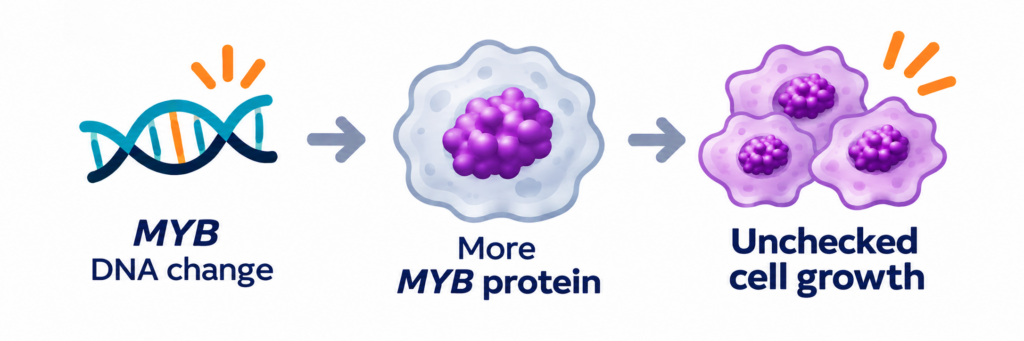
The MYB gene provides instructions for making a protein that helps control which genes are turned on or off in a cell, including genes involved in cell growth and survival. If MYB becomes overactive, it can lead to unchecked cell growth. High MYB activity has been observed in several types of cancer, including leukemia, colorectal cancer, and some breast cancers. However, MYB is only active in some cases of these cancers, while it is prevalent in almost all cases of ACC.
How Does MYB Become Activated in ACC?
In 2009, ACCRF-funded researchers identified that the DNA in and around the MYB gene was rearranged in many ACC tumors. We don’t yet know why these rearrangements happen but they don’t appear to be related to any health or environmental factors such as chemicals, viruses, smoking, or drinking. The best guess is simply random genetic malfunctions while cells are dividing.
Subsequently, more ACCRF grantees discovered that these MYB rearrangements were bringing bits of DNA called super-enhancers close to the MYB gene. These super-enhancers increase the production of MYB RNA, which carries the instructions for making MYB protein to the cell’s protein-making machinery. As a result, cells with the rearrangement produce higher levels of MYB protein.
Similar rearrangements involving the MYBL1 gene (a close cousin of the MYB gene) happen in about 10% of ACC patients. Further larger studies confirmed that almost all ACC tumors have high levels of either the MYB or MYBL1 protein.
Laboratory experiments have shown that recreating MYB rearrangements in normal salivary gland cells lead to the development of ACC features. Scientists have also found that reducing MYB activity in ACC cells slows or reverses their growth over time. Together, these findings provide solid proof that alterations in the MYB gene are responsible for driving ACC, and that blocking MYB could stop the progression of the disease.
How Can MYB Be Targeted?
For years, MYB was considered “undruggable” because its protein does not have an obvious pocket where a drug could attach and block its activity. This meant that even though researchers knew MYB was an important driver of ACC, finding a way to target it was a major challenge. That began to change as scientists developed a way to interfere with the process of MYB DNA turning into MYB RNA and then into MYB protein. These drugs, called RNA degraders, bind to MYB RNA and cause it to be broken down before the cell can use it to make new MYB protein. As a result, less MYB protein is produced in the cell which ACC tumors depend on.
Drug companies are now testing MYB-targeting RNA degraders in clinical trials for patients with advanced ACC. Early results have shown anti-tumor activity in some patients, providing preliminary clinical evidence that supports targeting MYB in ACC.
Looking Ahead
There is still much more to learn. As these latest clinical trials advance and yield new information, researchers are continuing to explore new ways to target MYB and MYBL1 along with other molecular targets of ACC. These efforts remain vital to ACCRF’s mission and to the global ACC community as we collectively search for new treatments and a cure. ACCRF will continue supporting this research and sharing what we learn.
You can read more about the history of MYB in ACC as well as a scientifically in-depth exploration of the ACC’s genetic drivers.
This article is part of our new FAQ series. If you have a question about ACC treatments and science that you would like to see answered in a future Research Update, you can submit them using the link below.


Leave A Comment