

ACC is one disease, but patients can have very different journeys. Some patients recur while others do not. Some patients recur soon after diagnosis while others may develop metastases only after a decade. And some recurrences grow quickly while others can be stable for years.
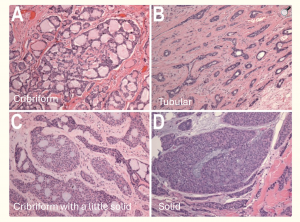
Researchers have steadily identified characteristics, or biomarkers, of ACC tumors that are associated with a more aggressive disease course or prognosis. These characteristics can provide useful information, but they do not guarantee how an individual patient’s cancer will behave. The growth pattern of tumor cells, known as histology, has long been associated with prognosis, with solid histology generally associated with a shorter survival than cribriform or tubular histology. The size of the primary tumor and the presence of perineural invasion also have prognostic implications. More recently, genomic research has identified additional biomarkers associated with aggressive disease, including 1p deletions, NOTCH gene mutations, and expression of proteins such as c-Kit, EN1, MYC, and B7-H4.
ACCRF grantees have been working to better understand which of these biomarkers are most useful for estimating prognosis and whether they can help simplify the assessment of ACC biology. In a 2021 study, researchers used genomic and protein analyses of ACC tumors to identify two molecular subtypes, called ACC-I and ACC-II. Both subtypes possessed the hallmark alterations involving the MYB or MYBL1 genes, but differed based on certain molecular features and correlated with disease aggressiveness.
Subsequent studies have further evaluated and supported these subtypes in independent patient groups, helping to clarify their relationship to tumor biology and patient outcomes. However, we still do not know which combination of biomarkers are most clinically useful for predicting prognosis, and the definitions of ACC-I and ACC-II may continue to evolve as researchers learn more.
With what we know today, ACC-I tumors tend to have solid histology, activating NOTCH mutations, lower levels of the biomarker p63, and higher levels of the cancer-associated gene MYC. Patients with ACC-I tend to have a more aggressive clinical course, with recurrence or progression often occurring within three years of diagnosis. ACC-I tumors are also associated with a higher frequency of metastases to the bone and liver.
Importantly, having one or even several of these features does not mean that a patient’s cancer will definitely progress more quickly. Every patient is unique, and a physician experienced in treating ACC can interpret these molecular and genetic findings in the context of the patient’s overall disease and clinical history.
ACC-II tumors tend to have cribriform or tubular histology and higher levels of the p63 biomarker. Patients with ACC-II tend to have a more favorable prognosis and a more indolent course. This may mean that the disease may be less likely to recur, and if recurrence or distant metastases do occur, these tumors may remain stable or grow more slowly. Such patients may have longer periods of observation or local therapy before considering systemic treatment. Recurrence or metastases may occur later after the initial diagnosis.
It is important to understand that “subtype” does not yet have one hard-and-fast definition that is used in every study. Subtypes can be defined using a combination of clinical, histological, and molecular features. For example, some studies use MYC and p63 levels as simpler markers to estimate whether a tumor fits the ACC-I or ACC-II pattern rather than performing a more complete analysis.
These differences in how tumors are categorized can also be reflected in clinical trial inclusion criteria, the specific requirements a patient must meet to participate in a trial. Some trials specifically enroll patients whose tumors meet criteria for the ACC-I subtype, which may include an activating NOTCH mutation, solid histology combined with a more aggressive clinical course, or low P63 and high MYC expression. Other trials may select patients based on a specific molecular feature alone, such as an activating NOTCH mutation. It is important to remember that, while there may be overlap, not all ACC-I tumors have an activating NOTCH mutation. Clinical trial eligibility can be complex, so patients should speak with their physicians to understand whether they may be eligible for a particular trial.

Researchers also know that ACC-I and ACC-II are not always mutually exclusive nor stable. Some tumors have biomarkers associated with both patterns, suggesting that there may be an intermediate group rather than two completely distinct categories. Researchers are still working to understand how common these intermediate tumors are and whether the molecular features associated with a subtype can change as the disease progresses.
ACCRF is supporting a global research project led by Dr. Renata Ferrarotto at MD Anderson Cancer Center to investigate these questions. Researchers are studying more than 700 tumor samples from 10 centers around the world to better understand how ACC-I and ACC-II are defined, whether an intermediate group exists, and how these biomarkers relate to patient outcomes.
Understanding these differences could eventually help researchers better predict how an individual patient’s ACC may behave and identify treatments that are better matched to the biology of their tumor. ACCRF will continue to share what we learn from this project and other research as our understanding of molecular subtypes evolves.