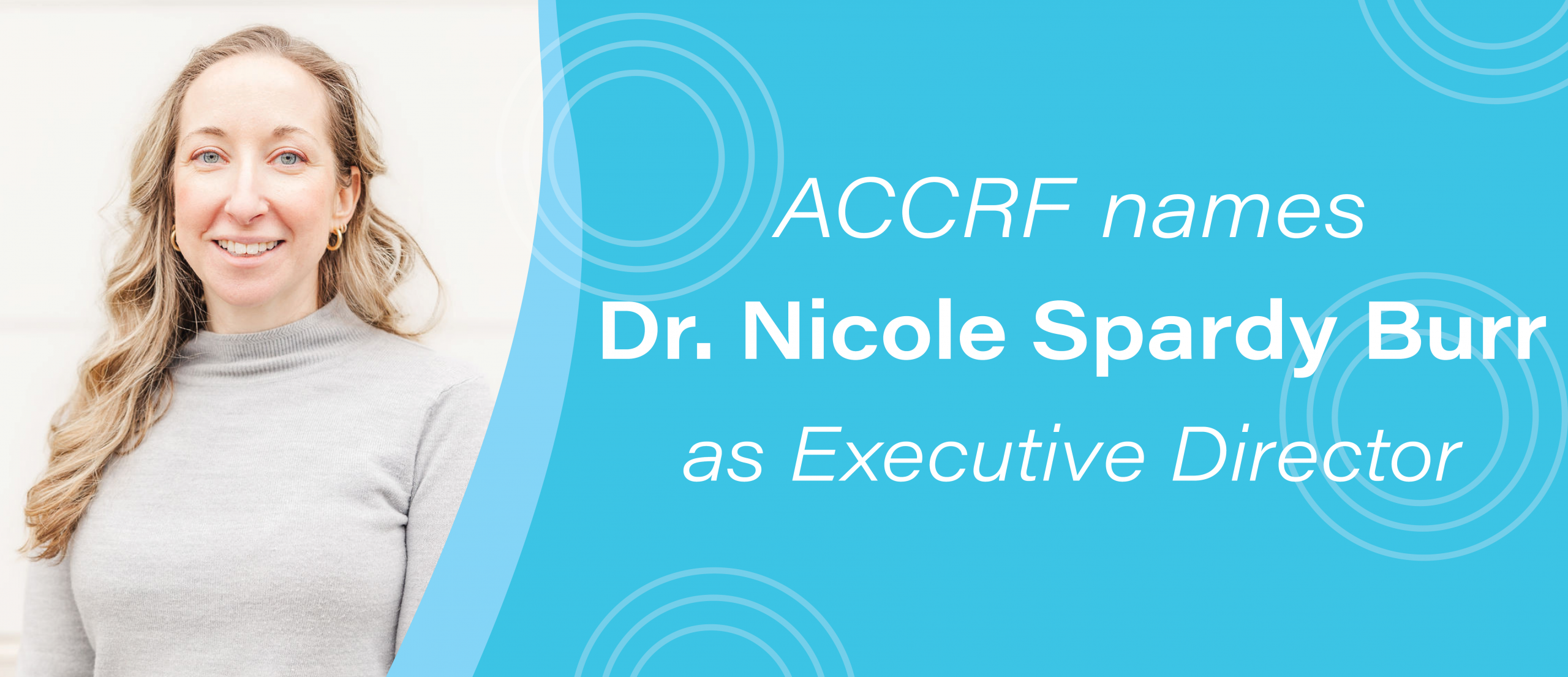
On February 24, 2026 ACCRF announced the expansion and fortification of its leadership which will allow the foundation to continue its groundbreaking research efforts while pursuing new fields of opportunity, including strategic initiatives, industry collaborations, and expanded patient education. Central to these efforts, Dr. Nicole (Nikki) Spardy Burr, PhD, has been named ACCRF Executive Director, overseeing all research and administrative activities. Dr. Spardy Burr sat down for a conversation about her new role, the frontiers of ACC research, and what’s next for the foundation.
ACC is a very rare cancer. What brought you to focus on a disease that many people have never heard of?
I have had a lifelong love of fundamental science and biology. I completed my BS in Biochemistry at Allegheny College and then my PhD at the University of Pittsburgh. However, it was during my post-doctoral training at the Dana Farber Cancer Institute that I realized I wanted to get closer to patient experiences. I began to connect with nonprofit research foundations, translating scientific concepts for the affected patients.
When I learned about how ACCRF was orchestrating world-class science from within a patient-driven organization, I knew I wanted to get involved. The opportunity to follow my passion for impactful science while getting to interact daily with the heroic patients facing significant challenges was very compelling. I’ve gotten to know so many ACC patients over the past decade and it brings me an immense sense of personal pride and gratitude to be able to orchestrate transformational research to meet their needs.
You’re stepping into the role of Executive Director of ACCRF after nearly a decade with the foundation. What has that trajectory looked like for you?

I joined the foundation in 2016 as a Scientific Programs Officer, helping to support the ongoing research efforts that Jeff and Marnie had built. From the beginning, I was blown away by the high caliber of science being funded. Deep discoveries had been made in such a relatively short amount of time that I knew the organization must be razor-focused on making a difference for patients.
In 2020, I was promoted to Director of Research, which gave me the opportunity to build on the incredible work that was already in place. My focus was on expanding our research network and strengthening the areas of research most likely to lead to better treatments for ACC patients. During this time, we grew our preclinical drug screening efforts, using ACCRF’s disease models to learn more about the therapeutic vulnerabilities of ACC. This helped to generate preclinical data that led to a major expansion in the number of clinical trials open to ACC patients.
Shortly after I became Director of Research, the COVID-19 pandemic hit. We were obviously limited with our in-person events, so we really focused on ways to stay connected with our community and expand our education and information sharing efforts. This led to the launch of our webinar program, which has become an important way for ACCRF to educate and engage with patients around the world and is one of my favorite programs the foundation offers.
There have been so many remarkable advances in ACC research in the last 20 years. Are there any that stand out as particularly promising during your time with the foundation?
I don’t think we can underestimate the importance of the ACC clinical trial pipeline that we’ve built over the last decade. In 2005, little was known about the underlying disease mechanisms of ACC. Clinical trials were small and rooted in science that largely flowed from therapies being tested in more common head and neck cancers, like squamous cell carcinoma, despite their substantial biological differences from ACC. In my time with ACCRF, we have pushed hard to change this by sponsoring grants to identify the genetic drivers of the disease, supporting the development of ACC models to assess the therapeutic potential of anti-cancer drugs, educating biopharma about ACC and advocating for the unmet clinical need of our patient community. Together, these efforts have helped to reduce the barriers for academic scientists to nominate new potential drugs and enable companies to generate the preclinical data in ACC required to advance therapies into clinical trials for patients.
The clearest example of how our clinical trial pipeline has worked relates to the MYB gene. Early funding from ACCRF helped scientists discover that MYB fusions are a defining genetic feature of ACC and supported the development of ACC patient-derived models that carry these MYB markers. This early work laid the foundation that accelerated the clinical development of promising new MYB-targeted therapies, some of which are now beginning to show real clinical benefit for ACC patients.
2025 was a banner year in terms of advances in antibody drug conjugates (ADCs) and clinical trials for ACC. With all of these advancements coalescing around the 20th anniversary, what are ACCRF’s priorities moving into the next decade of research?
2025 absolutely was a banner year! We’re seeing some of the strongest response rates to date with B7-H4 ADCs and emerging MYB degrader drugs, which is incredibly encouraging. But we cannot pin our hopes on one silver bullet to cure all ACC cases. We are continuing to invest in the science needed to replenish the clinical trial pipeline with a a diversity of new, promising therapies. Likewise we are investing in concrete ways to improve the patient journey, whether by making better predictions of how aggressive each patient’s disease will be or by helping patients choose among available treatment options for metastatic disease.
Case in point: there’s important new data emerging from our global p63 prognostic biomarker project led by ACCRF grantee Dr. Renata Ferrarotto at the MD Anderson Cancer Center that may validate a widely-accessible test to guide patients towards the most appropriate treatments and clinical trials. Our mission is rooted in taking a holistic view of the research landscape and understanding how we can use it to benefit the largest number of patients possible.
How do the recent shifts in research funding and support affect this work?
In many ways, ACCRF has always been in a strong position to help fill funding gaps for researchers doing this important work. For example, many of our pilot grants provide early funding for new and existing grantees, helping them to collect the first pieces of data they need to apply for much larger research grants. I’m also excited about welcoming into the ACC field new researchers with different tools to study our disease and helping to cultivate the next generation of scientists who are working and advocating for our patients.
And what does this work look like for patients?
We’ve always said that the best things we can give patients are high quality scientific information and better, more effective treatments. That has not changed and will not change. Education is at the heart of ACCRF’s mission, and for me that means continuing to deliver reliable information to our community through our website, newsletter, patient meetings, and webinars. We want patients to understand not just the biology of ACC but also the science behind different therapies so that they can advocate for the best possible care and treatments.
As you look to the future of ACC research, what makes you hopeful?
Especially for rare diseases, scientific breakthroughs require collaboration across many individuals to share samples, technologies, knowledge, and advocacy. The collegial partnerships among ACCRF’s grantees and the willingness of patients to be involved in funding research and participating in clinical trials give me hope that we will have the momentum needed to secure better outcomes for ACC patients. It truly takes a village to move the needle for patient care and being part of such a dedicated and supportive community of patients, grantees, physicians, volunteers, friends, family, and advocates reminds me every day that we have everything we need to make new treatments and a cure a reality.